
Just to see what would happen, let’s continue Tom’s compounding investment process for 10 years, where Tom keeps investing the previous year’s income in more shares.
At the end of 10 years, Tom has 1,032 shares, worth $8,248 at his original purchase price of $8.00 a share. He is now receiving $43 a month in dividend income. Not a lot of money, but remember he only started with $4,800. Without the price moving at all, he has almost doubled his investment!
Tom is now receiving $516 a year in dividend income, which now equals a 10.7% return on his original $4,800. And this is with no price appreciation on the stock for 10 years, which is highly unlikely if it is a good business that is profitable and able to pay dividends.
The stock I used in this example is real; it is Lexington Realty Trust (LXP) ,a real estate investment trust that yielded 6.3% when it was $8.00 a share 2 years ago. The current price is $12.44.
At the current price of $12.44, Tom’s investment is now worth $12,838.
If Tom had started with $48,000, he would now have a monthly income of $430, which can pay for a lot of monthly expenses like his cell phone, utilities, groceries, etc. That’s real money in anyone’s book! And with the stock price increase to just $12.44, his stock account would have increased to $128,380 after 10 years, almost triple what he started with!
Do what the rich do! Convert your wages or business income into solid assets that have long-term value and can provide you with income you can either compound or use today.
For the most part, this is accomplished by investing in real estate, dividend stocks, bonds, tax liens, or a business. These kinds of assets tend to appreciate in value, adjust for inflation, and provide income.

The key is to invest for income (cash flow) first, then capital gains.
Let me give you an example of the difference between investing for cash flow and investing just for capital gains.
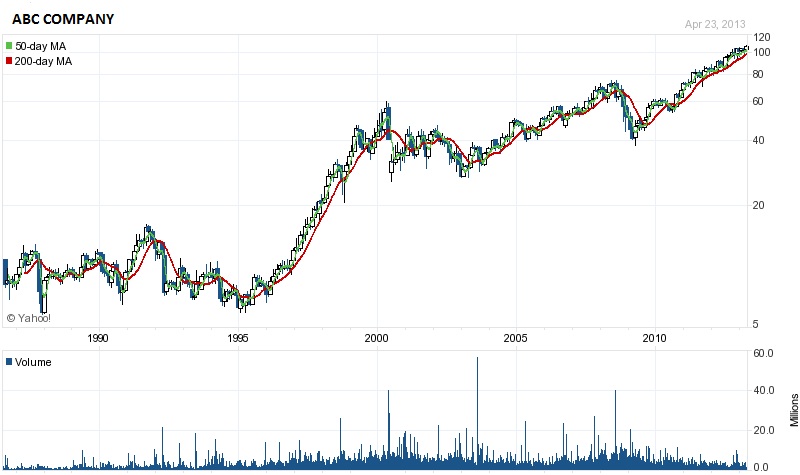
Mark buys 1,000 shares of ABC Company in 1995 for $7 a share. ABC Company does not pay a dividend.
He sells it in April 2013 for $100 a share. Mark made a $93 a share gain on his shares, for a total profit of $93,000. See the chart below.
If we subtract the original $7,000 he paid for the shares, Mark made a $86,000 capital gain on his stock purchase. Capital gains are gains that you realize when you sell something for a profit.
Chart courtesy of Yahoo Finance
(Click to enlarge)
Now, this is important: Notice that Mark doesn’t make any money unless his shares increase in price from what he paid for them.
This is investing for capital gains only;
in other words, investing in the hope that the
future price will be higher than the purchase price.
Let’s compare Mark’s purchase with Susan’s.
Susan buys 1,000 shares of XYZ Company in 1995 for $7 a share. XYZ pays a 6% annual dividend, and she reinvests the dividend amount each year in additional shares.
Susan also sells all her shares in April 2013 for $100 a share. But because she reinvested the dividends year after year, her original 1,000 shares had grown to 1,500 shares by the time she sold.
Susan received about $13,000 in dividends over this 18-year time period. Reinvesting the dividends over the years bought her an additional 500 shares.
Chart courtesy of Yahoo Finance
(Click to enlarge)
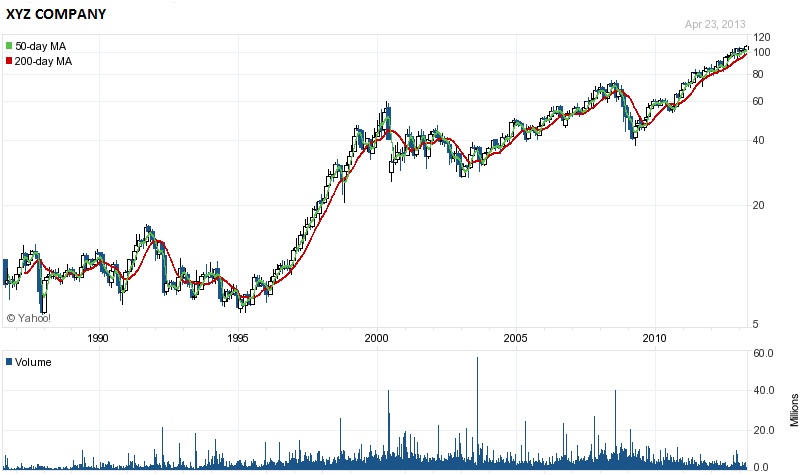
Susan made a $93 a share gain on 1,500 shares, for a profit of $139,500. Susan had a capital gain of $132,500 (139,500 minus her original 7,000 cost).
Susan made $46,500 more from her $7,000 investment than Mark did. She invested for income first, and capital gains second. This is the power of dividend-paying stocks.
One more important thing to realize: If the stocks they both purchased never increased in price after they bought them, Mark would have made $0 on his investment.
But Susan, even if she ended up selling the shares 18 years later at her original $7.00 purchase price, would still have made $3,500 because she ended up with 1,500 shares, not the 1,000 she originally started with.
Investing for cash flow, rather than solely for capital gains, shields you from the ups and downs of the markets. You are making money now, not by hoping your investment goes up in value.
If the price of real estate crashes 50%, but you have a good tenant in a rental property, you will still receive your monthly rent. The price of the house doesn’t affect the cash that you make from rents each month.
Your investment results do not solely rely on price gains, but also on cash flow. This is a very important point.
You also eliminate hope – the hope that your investment goes up in value so you can make money. Hoping frequently leads to investing incorrectly and losing money.
Investing for income and cash flow offers you the best of both worlds – income today and the prospect of capital gains in the future.
This is what the rich do. Invest like the rich!
[gpp_divider type=”dashed” color=”green”][gpp_divider type=”dashed” color=”green”]
The next time you want to purchase something, think about John and Tom. How can you purchase an asset or investment that will pay for what you want instead of just buying what you want?
For example, investing in AT&T or Verizon stock can pay for part or all of your monthly cell phone bill. How? Both of these stocks pay a quarterly cash dividend.
I’m not necessarily recommending that you buy these stocks. But it is the thinking behind this strategy that will change your life.
Change your thinking and you change your actions! Think about this!
[gpp_divider type=”dashed” color=”green”]


 Michael Benghiat is a successful independent investor, investing coach, and the founder of Lifetime Investor.He started out in the music business as a composer for film and TV, and gradually grew his investment portfolio of stocks, bonds, real estate, tax liens, and gold and silver into a six-figure income. You can learn more about Michael here.


Jodie
Pretty! This was an incredibly wonderful article.
Thanks for providing this information.
John
This is a great article. I’ve seen many explaining dividend stocks, compounding and not putting your eggs all in one basket. I think what most first time investors or people on the fence on whether to invest are concerned with is, who do we go to, who do you trust with your money? Instead of a stock broker who takes a percentage what are the trustworthy entities and websites to use that can maybe coach you along your first and future investments investment?
Michael
Hi John,
Always look for a fiduciary when dealing with investing professionals, whether they are wealth managers or stockbrokers. They are required by law to put your needs ahead of their own.